
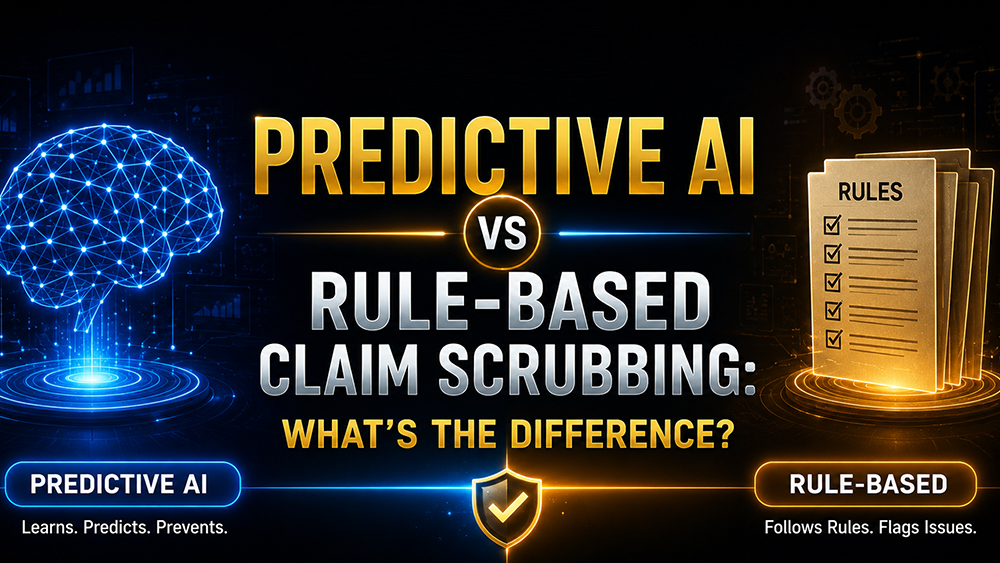
A claim can pass a traditional scrubber and still come back unpaid. That is one of the biggest limitations revenue cycle teams face when they rely only on rule-based claim scrubbing.
The reason is simple: rule-based claim scrubbing checks whether a claim violates a known rule, while predictive AI evaluates whether the claim is likely to be denied based on patterns learned from historical and current data.
That distinction matters because claim denials continue to put pressure on provider revenue. Recent industry data shows just how significant the problem has become. Kodiak Solutions reported that the initial claim denial rate increased to 11.81% in 2024, based on data covering more than 2,100 hospitals and 300,000 physicians. Meanwhile, KFF analysis of CMS Transparency in Coverage data found that HealthCare.gov insurers denied about 19% of in-network claims in 2024.
Therefore, the question for healthcare organizations is no longer simply whether claims are being scrubbed before submission. Instead, the more important question is whether the technology can identify which claims are most likely to fail and why.
What Is Rule-Based Claim Scrubbing?
Rule-based claim scrubbing is a traditional pre-submission validation process. It checks a medical claim against predefined rules to identify errors before the claim reaches the payer. For example, a scrubber may check whether a required diagnosis code is missing, whether a CPT and ICD-10 combination is incompatible, whether a modifier is absent, or whether a claim contains an invalid payer ID.
Consequently, rule-based scrubbing is extremely useful for catching known and clearly defined errors. However, the technology generally operates according to an if-this-then-that approach. If a claim meets a specific condition, the system triggers a predetermined response.
For example, if a required field is missing, the claim is flagged. If a procedure code is incompatible with a diagnosis according to a configured rule, the claim is stopped. This approach works well when the problem is predictable and the rule already exists.
Where Rule-Based Scrubbing Works Well
Rule-based claim scrubbing remains valuable because many claim errors are deterministic. A missing field, invalid code, duplicate claim, incorrect formatting issue, or obvious coding conflict can often be identified without machine learning.
Moreover, rules are easier for billing teams to understand and audit. A revenue cycle manager can usually see exactly which rule caused a claim to fail. Therefore, organizations should not view rule-based claim scrubbing as obsolete. The problem begins when organizations expect static rules to identify every possible reason a payer may deny a claim. That is where the limitations become more visible.
Why Rule-Based Claim Scrubbing Can Miss Denial Risk
A claim does not exist in isolation. Its payment outcome can depend on the payer, provider, location, procedure, diagnosis, authorization history, documentation, patient coverage, historical payer behavior, billing patterns and many other variables. A traditional rule engine may verify that a claim is technically valid while missing a more subtle risk pattern.
For instance, imagine a practice submits 1,000 claims for the same procedure. The claims pass standard edits. However, claims from one payer, one provider specialty and one particular diagnosis combination have historically experienced significantly more denials.
A conventional scrubber may allow those claims through because none violates a predefined rule. The result is predictable: the claim looks clean from a technical perspective but remains financially risky. This is one reason denial prevention requires more than checking individual claim fields.
What Is Predictive AI Claim Scrubbing?
Predictive AI claim scrubbing takes a different approach. Instead of relying only on fixed rules, a predictive model analyzes historical claim outcomes and identifies patterns associated with paid, rejected and denied claims. Depending on the available data, an AI model can evaluate signals such as payer, procedure, diagnosis, provider, place of service, authorization information, claim history, historical denial reasons and other relevant variables.
The model then estimates the probability that a new claim will experience a particular outcome. In simple terms:
Rule-based scrubbing asks: “Does this claim violate a known rule?”
Predictive AI asks: “Based on what we have learned from previous claims, how likely is this claim to fail?”
That difference can fundamentally change how a revenue cycle team prioritizes its work.
How an AI Model Predicts Claim Denial Risk
A predictive claim model typically starts with historical claim data. The system can learn from previously submitted claims and their eventual outcomes. Paid claims provide examples of successful patterns, while denied and rejected claims provide examples of risk patterns.
The model can then identify relationships that are difficult to represent through hundreds or thousands of manually written rules. For example, a model may discover that a particular payer-procedure-provider combination has a higher denial probability when certain documentation or authorization signals are absent.
The model does not simply look for one error. Instead, it evaluates multiple signals together. A simplified prediction workflow looks like this:
Historical claims → Data preparation → Feature engineering → Model training → Risk scoring → Claim prioritization → Human review → Outcome feedback → Model monitoring
Consequently, predictive AI can move claim prevention from a purely reactive process toward a more risk-based workflow.
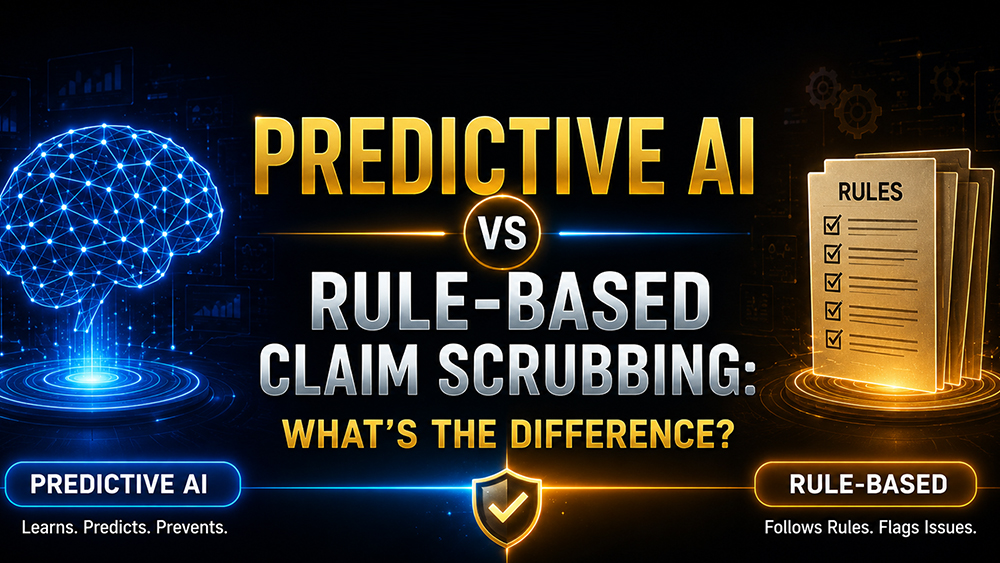
Predictive AI vs Rule-Based Claim Scrubbing: The Key Difference
The biggest difference is how each technology makes decisions. Rule-based systems depend primarily on explicitly defined business and payer rules. Predictive AI uses statistical and machine-learning models to identify relationships within historical data. A rule engine is generally deterministic. Given the same input and the same rules, it produces the same result. A predictive model is probabilistic. It can assign a risk score based on the combination of signals available for the claim.
That means a rule-based system might say: “This claim violates Rule 247.” Predictive AI might instead say:
“This claim has an elevated probability of denial because its characteristics resemble previously denied claims.” The second insight can be much more useful when the problem is not a simple coding or formatting error.
What Happens When You Combine Rules and Predictive AI?
For most healthcare organizations, the strongest strategy is not to choose one technology and eliminate the other. Instead, rule-based scrubbing and predictive AI can work together. The rules can identify known compliance, coding and data-quality problems. Meanwhile, predictive AI can identify less obvious patterns that indicate elevated denial risk.
For example, the rules can stop a claim because a required modifier is missing. At the same time, an AI model can identify another claim that technically passes validation but has a high probability of denial based on historical payer behavior.
This creates a layered claim prevention strategy. The first layer catches known errors. The second layer identifies hidden risk. The third layer can prioritize human intervention according to financial impact and denial probability. As a result, billing teams can spend less time manually reviewing every claim and more time focusing on claims that actually require attention.
Why Predictive AI Matters as Denial Patterns Change
Payer policies, documentation requirements and reimbursement practices can change. Therefore, a static rule library can become increasingly difficult to maintain. CAQH continues to highlight the financial impact of administrative complexity. Its 2023 Index estimated that healthcare organizations spent $89 billion on tracked administrative transactions, while fully electronic transactions represented an opportunity for approximately $18.3 billion in savings.
Furthermore, CMS continues to use data-driven approaches to identify improper payments and high-risk claims. For FY 2025, CMS reported a 6.55% Medicare FFS improper payment rate, representing an estimated $28.83 billion. These figures reinforce an important point: healthcare payment accuracy depends increasingly on the quality of data, validation and risk detection occurring throughout the revenue cycle.
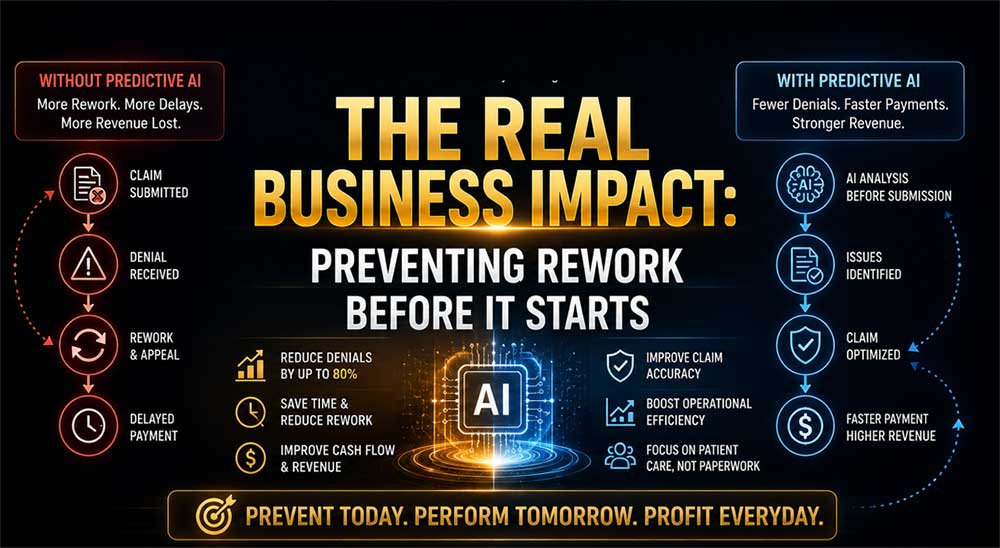
The Real Business Impact: Preventing Rework Before It Starts
A denial does not only represent delayed reimbursement. It can trigger manual review, payer communication, coding investigation, resubmission, appeal preparation and additional staff workload. Therefore, the real cost of a denial can extend well beyond the original unpaid claim.
Predictive AI can help organizations prioritize prevention by identifying claims that deserve additional attention before submission. For example, instead of asking a billing employee to manually investigate hundreds of claims, a system can identify a smaller group of high-risk claims and provide the factors contributing to the risk score.
That creates a more practical workflow:
Detect risk → Understand the reason → Correct the claim → Submit with greater confidence → Monitor the outcome
The objective is not to replace billing professionals. Rather, it is to give them better information at the moment when intervention can still prevent avoidable rework.
When Should a Healthcare Organization Use Predictive AI?
Predictive AI becomes particularly valuable when a practice or health system is dealing with increasing denial rates, high claim volumes, complex payer behavior or excessive manual claim review. It can also be useful when the organization already has a rules-based scrubber but continues to experience denials after claims pass pre-submission validation.
That situation is an important warning sign. If claims are consistently passing the scrubber and still being denied, the problem may not be a lack of rules. Instead, the organization may need a system capable of detecting patterns beyond deterministic validation.
How to Choose an AI-Powered Claim Scrubbing Solution
Healthcare organizations should look beyond the words “AI-powered” when evaluating a predictive claim solution. The important questions are how the model is trained, what claim data it evaluates, how prediction accuracy is measured, whether risk factors are explainable, how frequently performance is monitored and how new claim outcomes feed back into the system.
Model monitoring is particularly important. A model that performed well several months ago may require evaluation as payer behavior, coding practices, claim volumes and data distributions change. Therefore, an effective solution should support continuous performance measurement rather than treating AI as a one-time implementation.
Predictive AI Is the Next Layer of Claim Prevention
Rule-based claim scrubbing remains an important part of revenue cycle management because it is excellent at identifying known, deterministic errors. However, it cannot always recognize the hidden patterns that cause otherwise valid claims to fail.
Predictive AI addresses that gap by analyzing historical outcomes and multiple claim-level signals to estimate denial risk before submission. Therefore, the most effective approach is not necessarily Predictive AI vs Rule-Based Claim Scrubbing.
It is Predictive AI + Rule-Based Scrubbing. Rules provide consistency and control. Predictive models provide risk intelligence. Together, they can create a stronger pre-submission strategy designed to reduce avoidable denials, prioritize billing resources and improve revenue cycle performance.
For organizations still relying entirely on static claim edits, the next step is not simply adding more rules. It is understanding whether historical claim data can reveal the risks those rules cannot see.
Frequently Asked Questions About Predictive AI Claim Scrubbing
Is predictive AI better than rule-based claim scrubbing?
Predictive AI and rule-based scrubbing solve different problems. Rule-based systems are strong at detecting known errors, while predictive AI can identify patterns associated with future denial risk. Combining both approaches can provide broader claim prevention coverage.
Can AI predict whether a medical claim will be denied?
Yes. A properly trained predictive model can estimate denial risk by analyzing historical claim outcomes and relevant claim characteristics. However, predictions are probabilistic and should be monitored for accuracy rather than treated as guaranteed outcomes.
Does predictive AI replace medical billing teams?
No. Predictive AI should support billing professionals by prioritizing high-risk claims and identifying potential issues. Human expertise remains important for reviewing exceptions, correcting documentation and making final operational decisions.
How is AI claim scrubbing different from traditional claim scrubbing?
Traditional claim scrubbing primarily validates claims against predefined rules. AI claim scrubbing can additionally analyze historical patterns and generate a risk score for claims that may otherwise pass standard validation.
What should providers look for in predictive claim software?
Providers should evaluate model performance, explainability, data integration, payer-specific intelligence, monitoring capabilities, workflow integration and the system’s ability to learn from actual claim outcomes.
Turn High-Risk Claims Into Preventable Claims
If your claims are passing traditional scrubbing but denials are still increasing, adding more static rules may not solve the underlying problem.
Aiclaim’s AI-powered approach to claim intelligence is designed to identify denial risk before submission and help revenue cycle teams focus their attention where it matters most.
Explore how ClearClaim can help identify high-risk claims before they become costly denials.
CTA: Predict Your Claim Denial Risk Before Submission →
Lead Magnet: Download the AI Claim Denial Prevention Checklist and evaluate whether your current claim-scrubbing workflow is detecting known errors only—or identifying the hidden risks behind denials.